
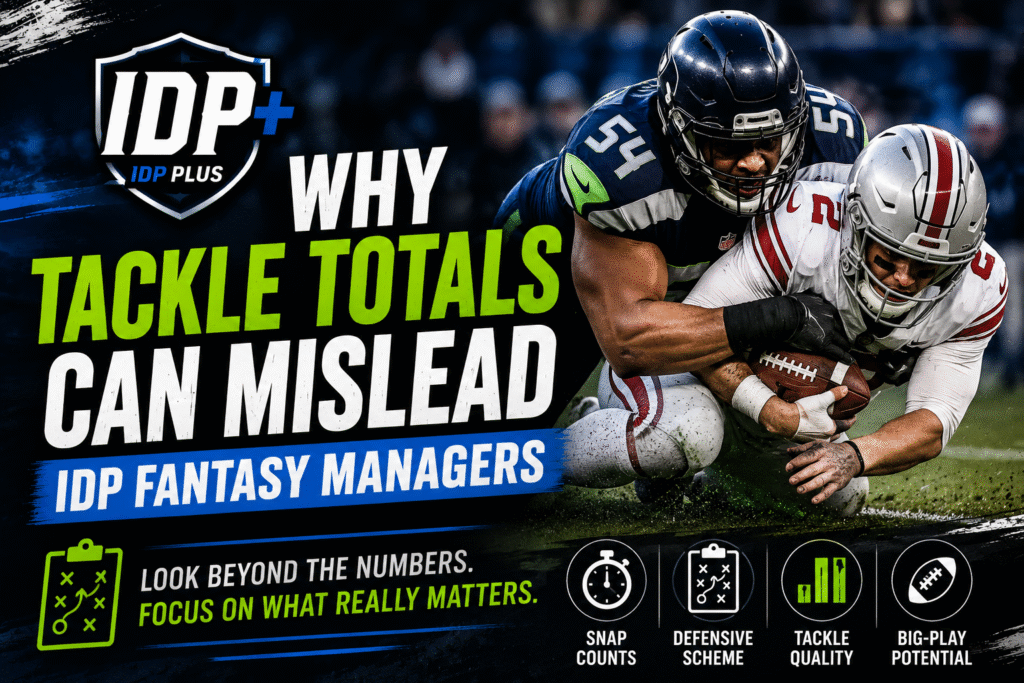
IDP tackle totals can be misleading without the right context. Learn why snap counts, defensive schemes, tackle quality, and big-play potential matter for fantasy managers.
In isolation, high tackle counts can provide a useful top-level measure of a player’s effectiveness. However, tackles represent only one part of the bigger picture when evaluating an IDP pick. The reasons are straightforward but easy to overlook, especially for newer fantasy managers. Here’s why it pays to look beyond raw tackle totals rather than getting hung up on one statistic.
Bad Defense May Be the Issue
In football, players make tackles when the offense has the ball. If a team’s offense goes three-and-out constantly, their defense stays on the field for 70+ snaps a game. More snaps naturally lead to inflated tackle opportunities.
So, for instance, you might find that an off-ball linebacker racks up 120 tackles due to always being on the field in defensive plays, which has little to do with how elite the player is in reality, and everything to do with how bad the team around him is. If in doubt, checking live NFL odds for Canadians will let you spot subpar teams with inflated tackle counts for individual players, giving you a better way to balance your picks and sidestep this common trap.
Not All Tackles are Created Equal
Some tackles are game-changing, while others provide little real-world defensive value. Low-impact tackles can also raise questions about a player’s overall effectiveness. IDP fantasy managers need to understand the difference.
A common example involves a safety or linebacker making a tackle eight to 12 yards downfield. The play may help your fantasy team, but it represents poor real-world defensive production.
Meanwhile, a tackle behind the line of scrimmage can disrupt an entire offensive drive. It may also carry greater value in many IDP scoring formats.
In short, avoid relying too heavily on players who accumulate most of their production through downfield tackles.
#FFIDP My IDP Draft Strategy articles over @MBFantasyLife. Get the prep you need for your IDP fantasy drafts.
Lineup Construction: https://t.co/RfotxC2ZCJ
Advanced stats to level up your draft: https://t.co/BotLq1dBcd
— Mike Woellert (@Mike_Woellert) August 12, 2026
Stats Can Be Skewed With IDP Tackle Totals
How tackles are recorded differs depending on whether the ones recording the stats are rooting for the home team or dealing with away games. It’s well known that some home stat crews are notoriously generous with assisted tackles, awarding two players a tackle on almost every play, for instance.
Conversely, other stat crews are conservative, only awarding solo tackles. This variance can artificially inflate or deflate a player’s fantasy production by 15–20% based purely on where they play half their games.
IDP Tackle Totals Volume Varies
A lot of variables impact tackle production, so this stat won’t be enough on its own to determine a player’s quality. For example, if a team is constantly winning and blowing out opponents, opposing offenses are forced to throw late in the game. This reduces tackle opportunities for linebackers while boosting sack/pass-breakup opportunities for edge rushers and corners.
In short, tackles provide a high floor, but volume without context is a mirage. IDF fantasy managers should prioritize talent, snap percentage, scheme stability, and big-play potential (sacks, TFLs, turnovers) over raw, unrefined tackle totals.

